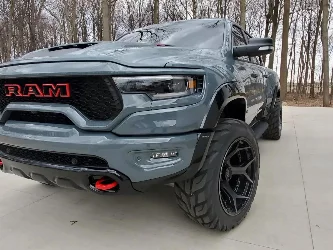
OEM Fuel Pump Replacement

Today I installed the pump and the East Coast driveshaft that’s been sitting in my garage for a year 😬. All I struggled with was some of the connectors - not being certain how to disconnect and fearing I might break them. Ratchet strap and jack definitely the way to go.

Here are two helpful YouTube videos for anyone looking to tackle this:


Also 12 ton jack stands are overkill! 6 ton were ideal.

Appreciate everyone’s support.
 
Last edited:
The lower lubricity of E85 is another potential issue that has been cited by fuel pump manufacturers. I’ve considered low dosing TC-W3 two stroke oil in my E85 fill ups to address that but haven’t gotten there yet. For now I take the Ford approach. When I store the TRX for a few months I fill it with Top Tier 93 and Red Line SI-1. And I guess if it still fails, it fails. Being in the rust belt I’ve dropped plenty of tanks for rotted pickup tubes, pumps, etc. Just the way it is. At least $1.69 a gallon and the power makes it worth the possible trouble down the road.

2. The pump materials and tolerances are more susceptible to the reduced lubricity of e85 as compared to gasoline. In this case running some pump gas every few months might help with lubricating the pump and seals.

The lubricity is a fair point, but I think it's a contributing factor rather than a root cause. Gasoline isn't very lubricious to begin with, which is why you have to add oil in two-stroke motors. The pumps are built with this in mind and are somewhat self-lubricating.


Yes and no. It does burn cleaner and good e85 is generally cleaner than e10 gas with additives but e85 also has a much wider range of quality. And if you end up getting something closer to e54 then you are getting a lot of additives that can come out of solution and build up residue.

That all said, while the pump does work a little harder to push a higher fuel volume, it’s still well within its design and operation limits especially when 95% of the operational time is spent cruising and idling. So the idea that it operating under a slightly elevated load dropped the pump life down by 80-90% doesn’t really make sense. However, my guess is that one of two specific things is happening.
Agreed that the variation in E85 can cause major issues.

As far as the workload vs reliability, you might be surprised how moving the maximum duty cycle even a little bit causes a rash of failures.

Something that is 98% reliable at a 70% duty cycle may only be 90% reliable at a 75% duty cycle, but that's a 5X on the number of failures even though 9/10 pumps are still doing just fine. Most of these pumps are nearing 100% on reliability metrics, so even a TINY shift seems massive when looking at the delta on the failure rate.
 
The lubricity is a fair point, but I think it's a contributing factor rather than a root cause. Gasoline isn't very lubricious to begin with, which is why you have to add oil in two-stroke motors. The pumps are built with this in mind and are somewhat self-lubricating.


Agreed that the variation in E85 can cause major issues.

As far as the workload vs reliability, you might be surprised how moving the maximum duty cycle even a little bit causes a rash of failures.

Something that is 98% reliable at a 70% duty cycle may only be 90% reliable at a 75% duty cycle, but that's a 5X on the number of failures even though 9/10 pumps are still doing just fine. Most of these pumps are nearing 100% on reliability metrics, so even a TINY shift seems massive when looking at the delta on the failure rate.
Duty cycle reliability at WOT is such a small percentage of working life that it will not have a significant impact on overall life expectancy as long as it is within the original design limits. The FOS margin on auto hardware dictates it. Now if you ran the pump above the design limits then I would agree that catastrophic failure based reliability can be significantly affected.

Either way, curious to see if just running a tank of pump gas every 3 months like Ford recommends keeps the pumps alive. So far this set has lasted longer than the last one. And every pump failure we have had is from nearly 100% e85 users…meaning the link seems to be lack of pump gas, not increased duty cycle.
 
Duty cycle reliability at WOT is such a small percentage of working life that it will not have a significant impact on overall life expectancy as long as it is within the original design limits. The FOS margin on auto hardware dictates it. Now if you ran the pump above the design limits then I would agree that catastrophic failure based reliability can be significantly affected.
Yes, but the second you swap a TRX to E85, you're outside the original design limits. E85 requires around 30% more fuel for the same amount of air. A 30% increase in the maximum duty cycle is huge from an engineering perspective. Yea, it's not a major change in the average duty cycle, but that's not where most of the wear and tear happens.

Either way, curious to see if just running a tank of pump gas every 3 months like Ford recommends keeps the pumps alive. So far this set has lasted longer than the last one. And every pump failure we have had is from nearly 100% e85 users…meaning the link seems to be lack of pump gas, not increased duty cycle.
Maybe. But as I said, even a SMALL change in the duty cycle can have HUGE changes in the reliability score. With how good the OEMs have gotten, there only being 30k TRXs made thus far, and them only being 5 years old, it's perfectly possible that there hasn't been a single pump failure on a stock truck that hasn't been mistreated. ANY failures vs. zero seems like a massive jump, even if it's less than a 1% difference.
 
Yes, but the second you swap a TRX to E85, you're outside the original design limits. E85 requires around 30% more fuel for the same amount of air. A 30% increase in the maximum duty cycle is huge from an engineering perspective. Yea, it's not a major change in the average duty cycle, but that's not where most of the wear and tear happens.


Maybe. But as I said, even a SMALL change in the duty cycle can have HUGE changes in the reliability score. With how good the OEMs have gotten, there only being 30k TRXs made thus far, and them only being 5 years old, it's perfectly possible that there hasn't been a single pump failure on a stock truck that hasn't been mistreated. ANY failures vs. zero seems like a massive jump, even if it's less than a 1% difference.
I disagree. The pump performance is still within the design limits unless you add a BAP. Both of my pump failures happened without a BAP. Input voltage was within the OEM limits and thus the design limits of the pump. Although you have 30% more fuel flowing at WOT versus pump gas (for similar hp builds where we have not seen pump failures), that does not equate 1:1 with pump duty cycle either. The pump is commanded a pressure and the injector sizing increase has an effect on the overall required performance as well. So that injector duty cycle balancing has the ability to reduce the effort from the pump. This is how many tuners setup WOT maps where FP would otherwise drop off anyway at higher RPM. Command lower pressure and lower duty cycle on the pump and let the injectors handle a larger pulse width. WOT performance is significantly less than 1% of total run time. Almost all wear on the components occurs during non-WOT operation. This is pretty standard for a brushed motor reliability analysis. And the lubricity issue for e85 on the fuel pumps is a known issue if you research it. All that said, I didn’t tear down my last pump to find the root cause of the failure so this is all conjecture and we will have to agree to disagree. If someone jumps in with a fuel pump failure that regularly runs both e85 and pump gas then that would put into question my hypothesis (and support your claim that most of the wear happens at WOT conditions) but it hasn’t happened yet.
 
Sigh... Look, man, I wrote out a response to about a quarter of what you said before I decided this wasn't a good use of our time.

The short response is this: I disagree. That disagreement is based on my years of designing electric/hydraulic pumping systems. I'd love to share my thoughts with you and hear more of yours, but typing them out on a forum just isn't the right format. If you're ever near Houston, I'd love to grab a beer and discuss. Until then, I think we can agree to disagree.
 
Myself and several others on the forum have actually done this job in the last year. Some advice that skips the AI summary posts that don’t have actual experience…

Rear axles on Jack stands. Remove driver rear wheel and fender liner for access to some of the evap lines and electrical connectors from the outside (much easier than from underneath). Remove the driveshaft for access and so you can see the connectors on top of the tank.

There are some YouTube videos online that walk through the process on similar 1500s just to familiarize yourself with connection points for the fuel lines, etc.

Be gentle with the fuel lines. They aren’t very sturdy IMO and the plastic clamps holding them on the frame rails can be a PITA.

Also, since you said the OEM pump is on the way out…any chance you are running e85?
I wish I had seen this sooner. I did not try to disconnect anything through the driver-rear wheel well. I had referenced the instructions on Lemon Manuals. It was not 100% accurate for the TRX. Their steps included disconnecting all lines and connections at the fuel hat before dropping the tank. I removed the driveshaft for more room but I struggled to get the lines disconnected with the very little room I had. It's possible but not a fun task.

I had to chisel away at a lot of pebbles stuck in the locking ring of the fuel hat to free it up. The next day I am free, I'll be installing the FID triple-pump kit and making my own -10an lines.
1000003865.webp
 
Does anyone know where this plastic fitting normally goes to? I found it and some loose electrical tape just sitting at the bottom of my tank.

1000004022.webp

1000004020.webp

1000004021.webp
 
I also found this tube floating towards the front of the tank. I can't find where any of it would go to.

1000004025.webp
 
Does this still require keeping the tank half full?
No, it's a returnless triple-pump kit utilizing a third FPCM. Therefore, the pumps are not running at full tilt the entire time like a return-style does which requires more fuel to keep the pumps cooled down. I'd still refrain from going WOT at 1/8th of a tank or less to avoid starving the pumps. It does not utilize a surge tank like the factory dual-pump fuel assembly.
 
Thanks for the reply and I agree about not running it hard to low. Half tank just seems to come pretty quick and I’m sure even faster for you.
 
No, it's a returnless triple-pump kit utilizing a third FPCM. Therefore, the pumps are not running at full tilt the entire time like a return-style does which requires more fuel to keep the pumps cooled down. I'd still refrain from going WOT at 1/8th of a tank or less to avoid starving the pumps. It does not utilize a surge tank like the factory dual-pump fuel assembly.
Generally speaking, a properly set-up return system won't run the pumps much harder than a returnless system. The pumps are still PWM, and if your regulator is post-rail, then they really only work as hard as the tune tells them to.

I've heard some people rave about the HydraMat for pumps without a surge tank, but I don't have personal experience with it.
 
Thanks for the reply and I agree about not running it hard to low. Half tank just seems to come pretty quick and I’m sure even faster for you.
You are correct, I only get around 200-220 miles per tank now. I take at least 6x VP racing jugs with me when I get ethanol so I can always top off before I head out for some fun. I eventually plan on getting a couple 55 gallon drums to require even less trips to the gas station.
 
Another DT flex tune with a dying pump here.

Where you guys even finding new pumps? Seems like every where is on backorder/unavailable right now. I was going to go triple pump but I will probably end up going back to 93 with 3.10 and get retuned by ZH. Gave up on modding the truck when I bought my hellcat lol
 
Another DT flex tune with a dying pump here.

Were you guys even finding new pumps? Seems like every where is on backorder/unavailable right now. I was going to go triple pump but I will probably end up going back to 93 with 3.10 and get retuned by ZH. Gave up on modding the truck when I bought my hellcat lol
When I ordered it was on backorder and took 10 days to ship but I now see it is marked unavailable as you note. Not sure what’s going on.

 
Dammit, I guess it was my turn.
IMG_4347.webp

Thankfully it crapped out in the driveway and not on the 50 mile trip I took yesterday.
 
Dusterhoff flex fuel. Been running E85 exclusively for around 7k miles, except for winters on 93. Guess that’s all it had in it.

If I can’t get an OEM replacement within a couple days I will likely bite the bullet with the Barth triple pump setup. Just really tight on time and would prefer the quickest and easiest repair.
 
Stock one is backordered of course, so Fuel Injection Depot triple pump ordered from @Nick797. Don’t really need the capacity but hopefully it’s just more durable.
 

TRX Forum Favs 👍

Back
Top